
Journal · Plant care
Watering houseplants in winter: how often, and how to check the soil
Water less often than in summer, and go by the soil, not the calendar. Push a finger into the potting mix: if it is dry about an inch (2.5 cm) down, water until it runs out of the bottom of the pot, then empty the saucer. If it is still damp, wait.

Why plants need less water in winter
Plants grow more slowly in winter, so they need less water (RHS). Illinois Extension puts it this way: most houseplants are not actively growing, so they use less (Illinois Extension). In the northern hemisphere (the sources here are from the US and UK), indoor light is lowest from late autumn through December and improves in January (same source).
Nebraska Extension gives an example: a plant that needed water daily outdoors in summer may need it only once a week or less indoors in winter (Nebraska Extension). It is an example, not a schedule. Iowa State says it plainly: how often depends on the species, the potting mix, and the temperature, light and humidity of the room (Iowa State).
How to check the soil
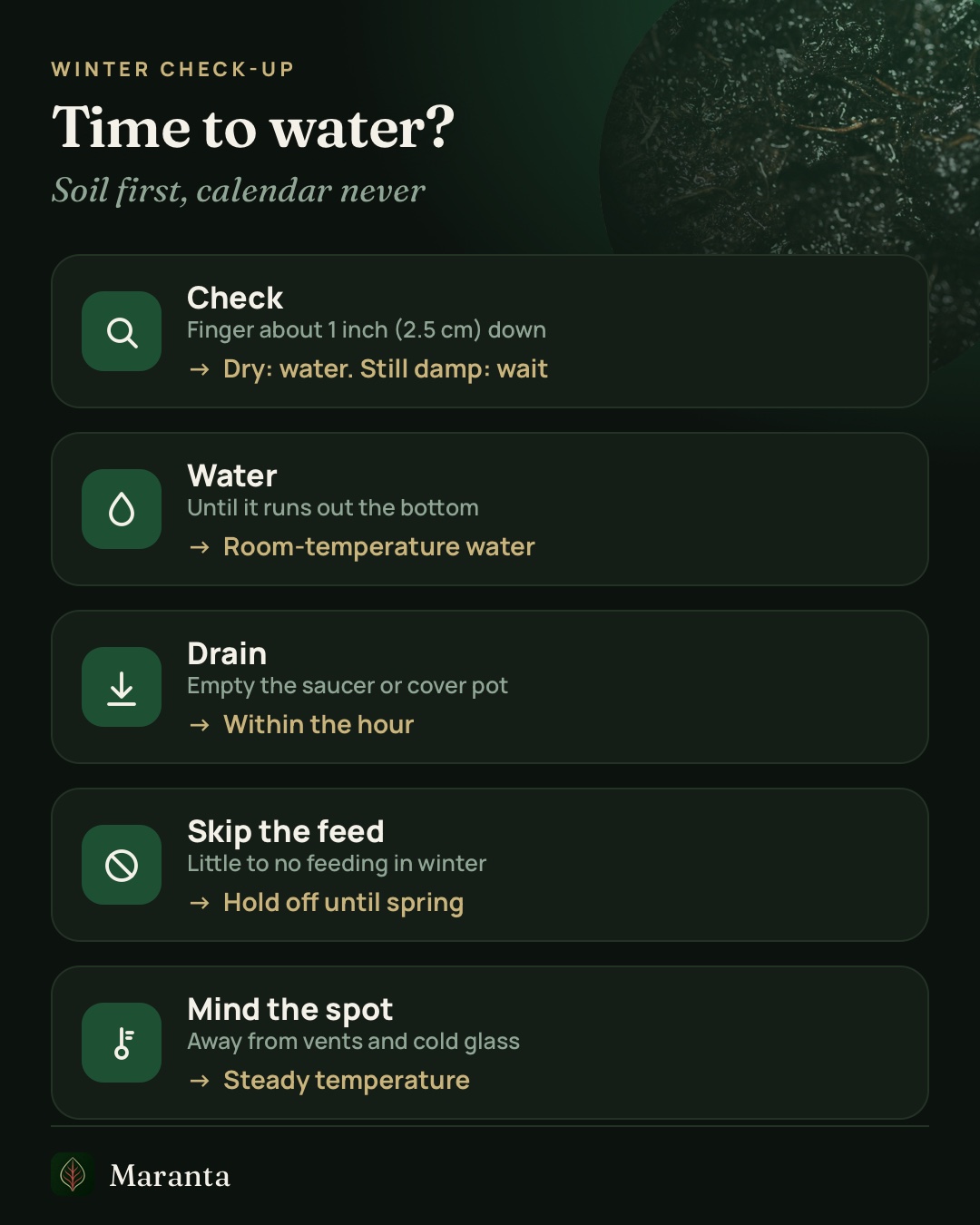
- The finger test. Touch the soil. Iowa State: when it is dry to the touch about an inch down, water (Iowa State). UConn and Nebraska Extension say the same (UConn, Nebraska Extension).
- The chopstick. Push a wooden chopstick into the soil. If soil sticks to it, don’t water; if it comes out clean, water (UVM Extension). A moisture meter works too (same source).
- The calendar? No. UConn: instead of watering by the calendar, check your plants often (UConn).
Aim for soil on the drier side, but not so dry that the plant wilts (Illinois Extension). Overwatering is the most common cause of houseplant death, because roots need air between waterings (Nebraska Extension).
How to water once the soil is dry
Water thoroughly, until water comes out of the drainage holes at the bottom, and throw away what drains out (Iowa State). UConn adds two details: room-temperature water is preferable, and saucers or cover pots should be emptied within an hour or so, because standing water keeps the mix saturated and pushes out oxygen (UConn). With a decorative cover pot, RHS suggests checking 10 minutes after watering and tipping away the excess (RHS).
If a pot has dried out so much that the mix pulls away from the sides and water runs straight through, UConn suggests submerging the whole pot in water until the air bubbles stop, then draining it well (UConn).
What changes from plant to plant
Leaf type. Plants with thick or waxy leaves, or few leaves, need less water than plants with lots of soft, lush leaves (UConn).
Cacti and succulents. They still need lots of light in winter, and Nebraska Extension recommends keeping them cool: 55–60 °F (about 13–16 °C), and not below 45 °F (about 7 °C) (Nebraska Extension). Some cacti and succulents go into a deeper winter rest (UVM Extension).
Ferns, prayer plants and calatheas. They like high humidity (Nebraska Extension), so water them when the soil needs it and give the air some help (see below).
Alocasia and caladium. They may drop leaves in winter. UVM says this is normal and they should bounce back in spring (UVM Extension).
Cyclamen. Water from the base and don’t overwater, because they can rot (RHS).
5 winter watering mistakes
- Watering as much as in summer. Plants grow more slowly in winter and need less water (RHS), and Iowa State says to water less often than in spring and summer (Iowa State).
- A full saucer or cover pot. Standing water can kill roots (UConn). A pot that is too big for the roots holds water they can’t use, with the same result (same source).
- Feeding. Houseplants need little to no feeding in winter (RHS), and UVM says to hold off on fertilizing and repotting unless it is really necessary (UVM Extension). Too much fertilizer can build up salts in the soil and damage roots; burned or dried leaf edges can be a sign (Nebraska Extension).
- Hot or cold spots. Plants dry out faster near heat sources (UConn). Turn off or redirect hot, dry air from vents (Illinois Extension) and keep plants out of draughts and off cold windowsills (RHS).
- Not looking for gnats. Fungus gnats become a problem with overwatering (UVM Extension), so plenty of gnats may be a sign you are watering too much.
Dry winter air
Winter heating lowers indoor humidity, and tropical plants especially benefit from a boost. Group plants together, stand pots on a tray of pebbles with water below the pot, and keep plants away from heat vents (UVM Extension, Illinois Extension). Crispy leaf edges? Read brown leaf tips: 4 causes and what to do.
The Maranta team
Sources
- Iowa State University Extension — How often should houseplants be watered during winter months?
- University of Illinois Extension — Houseplants: winter watering and humidity
- University of Nebraska–Lincoln Extension — Winter care of indoor plants
- UConn Home & Garden Education Center — Houseplant watering recommendations
- University of Vermont Extension — Houseplant care during winter months
- RHS — Winter houseplant care
Photos: Karine A and Artem Podrez on Pexels (Pexels License). Graphics: Maranta.