
Journal · Plant care
Poinsettia care: why it drops leaves, and is it toxic to cats and dogs?
Keep it warm (not below roughly 13–16 °C / 55–60 °F), in bright light without direct sun, away from draughts and radiators, and water only when the surface of the soil feels dry. As for pets: the ASPCA lists the poinsettia as toxic to dogs and cats, but the effect is usually mild, mostly an upset mouth and stomach.

The red parts are not petals
Those showy red, pink or cream parts are bracts, which are modified leaves. The real flowers are the tiny yellow clusters in the centre (RHS, UConn). When you buy one, UConn suggests choosing a plant whose yellow buds are still closed.
The poinsettia is native to Central America, especially western Mexico, and it is not frost tolerant (UConn). That explains most of its sulks: it hates cold.
The trip home is the first test
The RHS says the most common cause of leaf and bract drop is cold: plants displayed on cold pavements or in draughty shop doorways. Choose one from a warm shop, wrap it well for the walk to the car, and never leave it in a parked vehicle (RHS, UConn).
Why it drops leaves (and what to do)
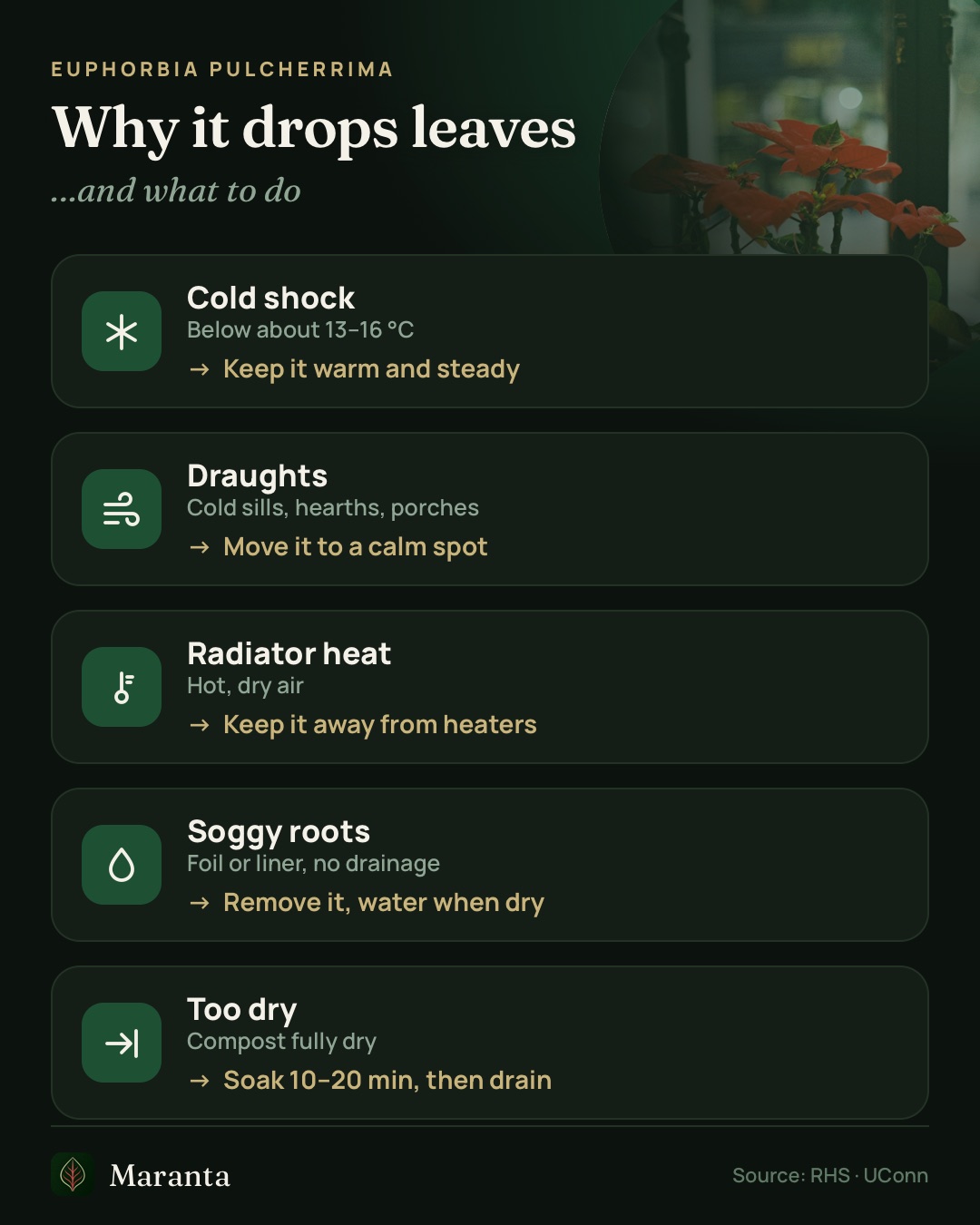
- Cold shock. Below about 13–16 °C (55–60 °F) the plant goes into “physiological shock” and drops leaves and bracts. Aim for a steady 16–21 °C (65–70 °F) (RHS, RHS).
- Draughts. Cold windowsills at night, spots behind curtains, draughty hearths and unheated porches all do damage. Choose a bright, still spot out of direct sun.
- Radiator heat. Hot, dry air is just as bad as cold. Keep it away from radiators, heaters and wood stoves (RHS, UConn).
- Soggy roots. Remove foil covers or plastic liners that have no drainage holes. Overwatering encourages root rot (UConn) and grey mould (RHS).
- Too dry. Water when the surface of the soil feels dry. The RHS method: stand the pot in tepid water for 10–20 minutes, drain it well, then put it back in its decorative pot.
If leaves start falling after you get it home, check that the room is warm and light and that the soil is just moist. The RHS says plants should stop dropping once conditions improve, though a plant already damaged by cold may not recover.
Can you make it red again next year?
Yes, but it is a project. The plant sets its colour when the days are short, so it needs weeks of long, unbroken nights. The RHS suggests 8–10 weeks of short days from late September, covering the plant or moving it to a dark room after twelve hours of daylight. UConn suggests cutting it back to about 8 inches (20 cm) after the bracts fade, then from 1 October giving it darkness from about 5 pm to 7 am for 10 weeks; colour should return in late November. The details vary by source, but the rule is the same: no light at night. Any light during the dark hours can affect flowering (NC State Extension).
Is a poinsettia toxic to cats and dogs?
The ASPCA lists it as toxic to dogs and cats because of an irritant sap, with irritation of the mouth and stomach and sometimes vomiting, and adds that its toxicity is generally overrated. ASPCA Pro calls it the most misrepresented plant when it comes to toxicity: it usually causes some stomach upset, mainly vomiting or diarrhoea. UConn also rates it as mildly toxic to pets and people. The milky sap can irritate skin and eyes (RHS, NC State Extension), so wash it off. Keep it out of reach, and call your vet if your pet seems unwell.
The Maranta team
Sources
- RHS — How to grow poinsettias
- RHS — Poinsettias (plant guide)
- UConn Home & Garden Education Center — Poinsettia
- NC State Extension, Henderson County — Poinsettia Care
- ASPCA — Poinsettia (toxic and non-toxic plants)
- ASPCA Pro — 4 Holiday Plants That Cause More Worry Than Warranted
Photos: Shayla Bruins, Merrilee Schultz and Daniel Cabanas on Unsplash (Unsplash License). Graphics: Maranta.