
Journal · Plant care
Christmas cactus or Thanksgiving cactus? How to tell, and why the buds drop
Look at the edges of the flat stem segments. Pointed, claw-like teeth: Thanksgiving cactus (Schlumbergera truncata). Smooth, rounded scallops: Christmas cactus (Schlumbergera × buckleyi). And if the buds are falling off, the usual culprits are a sudden change, dry soil or the wrong temperature.

Three clues that settle it
Thanksgiving cactus
Schlumbergera truncata
- Segments: 2–4 pointed teeth along the edges, claw-like tips (hence its other name, “crab cactus”)
- Flowers: held out sideways
- Anthers: yellow
- Blooms: from about mid-November, roughly a month before the Christmas cactus
Christmas cactus
Schlumbergera × buckleyi
- Segments: rounded, scalloped edges, no points
- Flowers: hang downwards
- Anthers: purplish-brown
- Blooms: from late November into winter
Here’s the twist: the plant on shop shelves in November is usually the Thanksgiving cactus, often sold under the name “Christmas cactus”. Extension horticulturists note it is the one most often found for sale over the holidays, simply because it flowers right on time (Clemson University, NC State Extension).
Does it matter which one you have? Not much for care. Both are forest cacti from Brazil that grow on tree branches in shady rainforests, and extension guides care for them the same way. What changes is the timing. (The Easter cactus is a different plant that flowers in spring.)
Why the buds drop (and what to do)
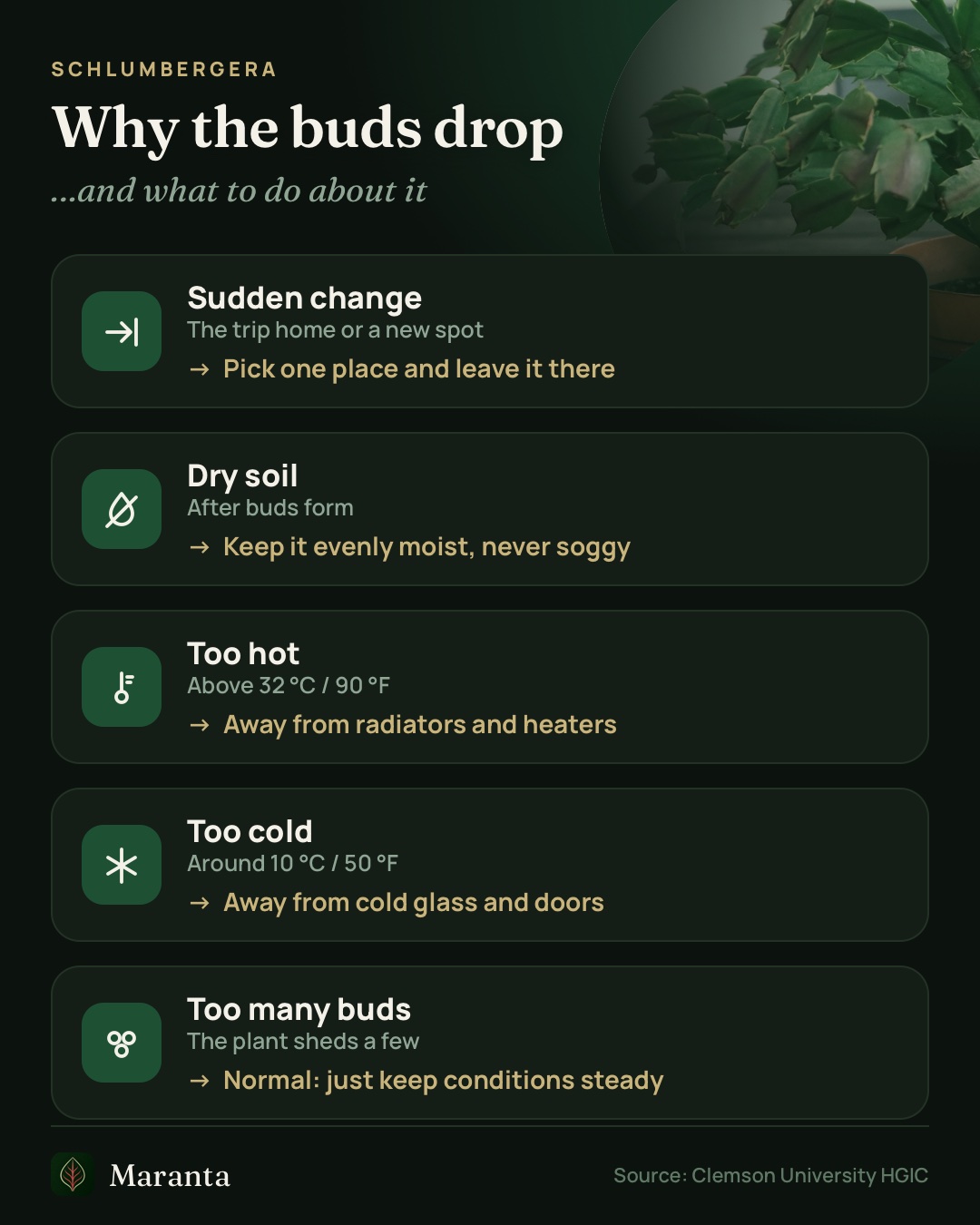
Holiday cacti are famous for dropping unopened buds. Clemson University lists the usual triggers:
- A sudden change. A jump in temperature, light or surroundings is enough, and the trip home from the shop counts (Iowa State). Once buds have formed, choose a spot with bright, indirect light and leave the plant there.
- Dry soil. After buds form, keep the potting mix evenly moist. Water when the top feels dry to the touch and empty the saucer. Don’t overdo it: overwatering is the top reason these plants die indoors (Almanac).
- Too hot. Temperatures above about 32 °C (90 °F) after bud set can make buds fall. Keep it away from radiators, heaters and hot-air vents.
- Too cold. Buds can also drop at around 10 °C (50 °F). Don’t press it against cold window glass or put it next to a draughty door.
- Too many buds. A plant loaded with buds may shed some on its own. Keep conditions steady and enjoy the rest.
No buds at all? Give it long nights
These are short-day plants: long, dark nights trigger the flowers. From about mid-September, give 14 hours or more of uninterrupted darkness every night for at least 6 weeks. Even a couple of hours of lamp light in the evening can stop buds from forming, so a spare room you don’t use at night is ideal (Clemson).
The other route is cool nights: around 10–15 °C (50–59 °F) sets buds whatever the day length, though the plant grows more slowly. Stay towards the warmer end, because buds can drop at 10 °C (50 °F). In autumn, keep it at about 15–20 °C (60–68 °F) overall, as close to 20 °C as you can. Buds usually show up 3–4 weeks into the treatment (NC State Extension).
Is it safe for cats and dogs?
Yes: the ASPCA lists the Christmas cactus as non-toxic to dogs, cats and horses, and NC State Extension lists the Thanksgiving cactus as non-toxic to cats and dogs. Non-toxic doesn’t mean it’s a snack: pets that eat a lot of it can still get vomiting or diarrhoea (ASPCA). If your pet seems unwell after eating any plant, call your vet.
The Maranta team
Sources
- Clemson University Home & Garden Information Center — Thanksgiving & Christmas Cacti
- NC State Extension — Christmas or Thanksgiving Cactus?
- The Old Farmer’s Almanac — Christmas, Thanksgiving and Easter cactus
- ASPCA — Christmas Cactus (toxic and non-toxic plants)
- NC State Extension Plant Toolbox — Schlumbergera truncata
- Iowa State University Extension — All About Holiday Cacti
- ASPCA Pro — 4 Holiday Plants That Cause More Worry Than Warranted
Photos: Merrilee Schultz, Ruslana Mushtyn and Ivett M on Unsplash (Unsplash License). Graphics: Maranta.